

DEF Sensor Problems Symptoms, Testing and Repair

DEF Sensor Problems: Symptoms, Testing and Repair
Modern diesel aftertreatment systems depend on more than a tank of fluid. The vehicle must know how much DEF is available, whether it is cold enough to freeze, whether the pump can build pressure, whether the injector is dosing correctly, and whether the SCR catalyst is reducing nitrogen oxides.
This guide explains common DEF sensor problems and the symptoms linked to the level sensor, pump, injector, heater, and NOx sensors. The goal is to identify the failed function before replacing parts. Exact tests and repair procedures vary, so confirm the diagnosis with service information for the vehicle.
Key Insights
- A low-level warning with a full tank often points toward a sensor or wiring problem.
- Pump faults usually appear as pressure, dosing, or system-performance problems.
- Injector deposits can restrict flow or distort the spray pattern.
- Heater faults are often most noticeable during cold weather.
- NOx sensors measure exhaust results; DEF sensors monitor the fluid and delivery system.
How the DEF Sensor Network Works
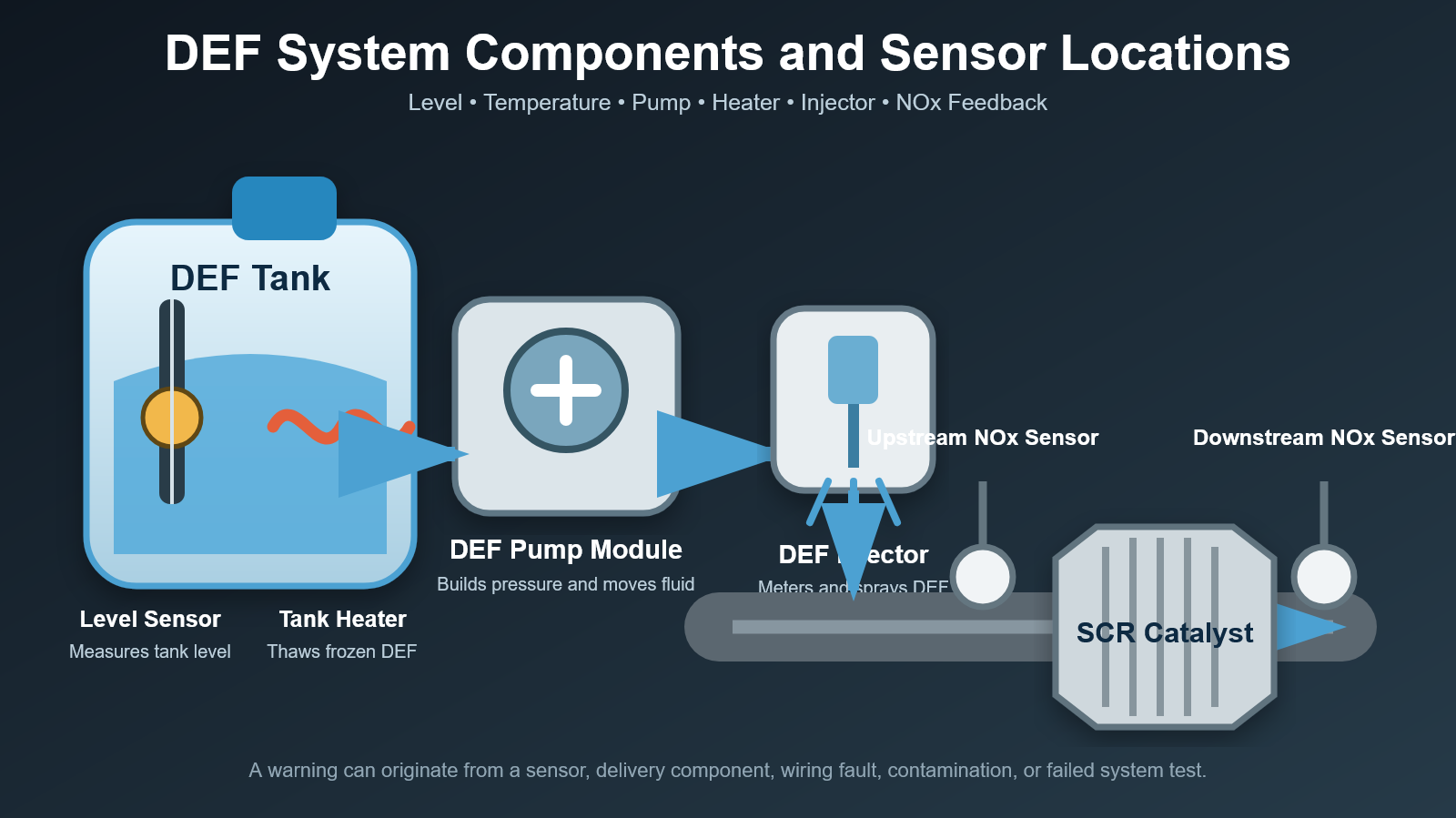
The level and temperature sensors are commonly located in or near the tank. The pump sends fluid through heated lines to the injector. The injector sprays DEF into hot exhaust, and NOx sensors before and after the SCR catalyst help the control module judge conversion performance.
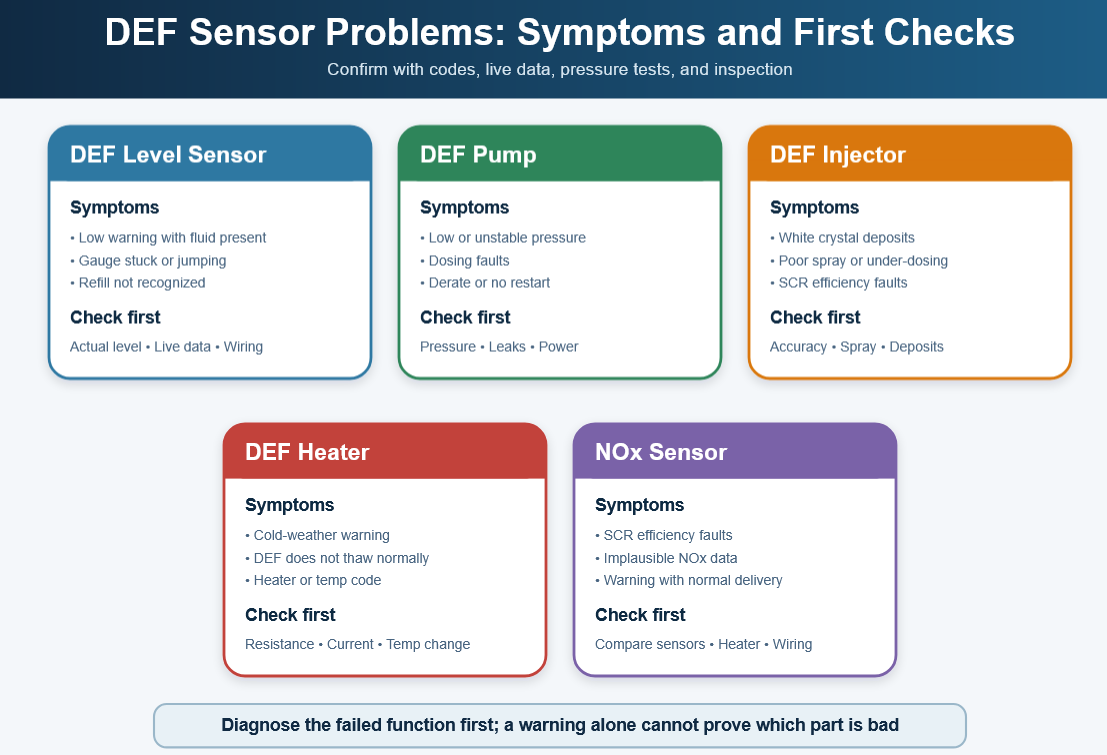
A warning may not identify the failed part. Fluid, wiring, deposits, exhaust leaks, or software can resemble a bad sensor.
DEF Level Sensor Failure Symptoms
Common DEF level sensor failure symptoms include a low-fluid warning when the tank contains DEF, a gauge that stays fixed, sudden jumps in the displayed level, or a refill that is not recognized.
- A mileage or restart countdown despite adequate fluid
- A level-related code that returns after refilling
- An implausible reading in scan-tool live data
- A warning that changes with temperature or tank movement
Confirm the physical level first. Then compare scan-tool data, check wiring, and inspect for contamination or crystallized residue. Some sensors are built into a complete tank or pump module rather than sold separately.
DEF Pump Failure Symptoms
Typical DEF pump failure symptoms involve pressure and delivery. The pump may fail to prime, build pressure too slowly, lose pressure, run noisily, or fail a commanded override test.
- A service DEF system message
- Reductant pressure or performance codes
- Derate or no-restart countdowns
- Little or no injector dosing during a service test
- Leaks or white deposits near lines and fittings
Clogged DEF Injector Symptoms
Common clogged DEF injector symptoms include white crystal buildup near the dosing area, low delivered quantity, an uneven spray pattern, SCR efficiency faults, or reductant-quality performance codes.
Cummins provides dedicated doser-accuracy and system-leak tests because visual inspection alone cannot prove that the injector works correctly. A doser may be electrically active but still deliver too little fluid or spray it poorly.
Check fluid quality, line pressure, commanded dosing, injector quantity, and exhaust deposits. Clean or replace components only through an approved procedure; forcing tools into the nozzle can damage its calibrated openings.
DEF Heater Failure Symptoms
Common DEF heater failure symptoms often appear when temperatures fall below DEF’s freezing point. The vehicle may show heater-circuit or tank-temperature codes, fail to thaw the fluid normally, or begin a fault countdown during cold operation.
A heater problem can involve the tank heater, heated line, pump heater, wiring, fuse, relay, or control module. Test resistance, current draw, supply voltage, and temperature change according to the service procedure.
NOx Sensor vs DEF Sensor
The difference in NOx sensor vs DEF sensor is location and purpose. DEF sensors monitor the fluid or delivery system. NOx sensors sit in the exhaust and measure nitrogen oxide concentration before or after the SCR catalyst.
- DEF level sensor: estimates how much fluid remains.
- DEF temperature sensor: helps manage freezing and heating.
- DEF pressure feedback: confirms the pump can deliver fluid.
- Upstream NOx sensor: measures NOx entering the SCR system.
- Downstream NOx sensor: helps verify catalyst conversion.
A biased NOx sensor can make a healthy dosing system appear ineffective. A failed level or temperature sensor can create warnings even when NOx conversion is normal. Compare related codes and live data before deciding which sensor is faulty.
A Practical Diagnostic Process
- Save codes and freeze-frame data.
Record the exact warning and operating conditions. - Check fluid and visible conditions.
Verify level, quality, leaks, freezing, and crystal deposits. - Inspect wiring and connectors.
Look for corrosion, loose pins, damage, and poor grounds. - Compare live data.
Review level, temperature, pressure, dosing, and NOx readings. - Run supported service tests.
Use pump, heater, leak, and doser-accuracy tests when available. - Repair and verify.
Clear codes only after repair, then complete the required monitor or drive cycle.
Cummins diagnostic tools include pump override, pump-heater, doser-accuracy, leak, and intermittent-connection tests. That test-first approach helps separate a failed component from a wiring, fluid, or operating-condition problem.
Frequently Asked Questions
Can a DEF level sensor fail with a full tank?
Yes. The system can report low level because of a failed sensor, wiring issue, frozen fluid, contamination, or an unstable reading.
Can a weak DEF pump cause derate?
Yes. If the pump cannot build or maintain pressure, the system may set performance faults and eventually apply operating restrictions.
Can DEF crystals clog the injector?
Yes. Deposits can restrict flow or change the spray pattern, especially when contamination, leakage, or poor conversion conditions exist.
Does a heater code mean the DEF is bad?
No. A heater code normally points toward the heating circuit, wiring, control, or temperature feedback rather than fluid quality alone.
Can a bad NOx sensor look like a DEF problem?
Yes. Incorrect NOx readings can make the system appear to be under-dosing or failing to reduce emissions.
Should I replace all DEF sensors together?
No. Test the failed function and related wiring first. Replacing multiple parts without evidence increases cost and may not solve the warning.
Conclusion
DEF sensor problems can involve level, temperature, pressure, dosing, heating, or NOx feedback. Symptoms overlap, so a dashboard message cannot prove which component failed.
Record the codes, inspect the system, compare live data, run supported tests, and replace only the part that fails verification.
Diagnose DEF Sensors With Evidence
Explore our DEF Sensors, Pumps & Injectors guides for level sensors, heaters, pressure faults, injector deposits, NOx sensors, derates, and repair procedures.

Other Articles
DEF Crystallization Causes, Cleaning and Prevention
DEF Fault Codes: P20EE, P207F, P203F, P204F and P205B
No Comment! Be the first one.