

DEF Fault Codes: P20EE, P207F, P203F, P204F and P205B

DEF Fault Codes: P20EE, P207F, P203F, P204F and P205B
A diagnostic trouble code records a test the vehicle failed; it does not automatically identify the part to replace. The same code can result from fluid quality, pressure, temperature, dosing, exhaust conditions, sensors, wiring, or catalyst performance.
This guide explains five common DEF fault codes, what each code points toward, and which checks should come first. Exact procedures vary by manufacturer, engine, model year, and software, so confirm all tests with service information for the vehicle.
Key Insights
- Read all stored, pending, and permanent codes before clearing anything.
- P20EE and P207F can be caused by dosing, sensor, fluid, exhaust, or catalyst problems.
- P203F normally means low DEF level, even when the physical tank appears full.
- P204F is a broad system-performance code and should be diagnosed with related codes.
- P205B points toward an implausible DEF tank temperature signal.
Before Diagnosing Any DEF Code
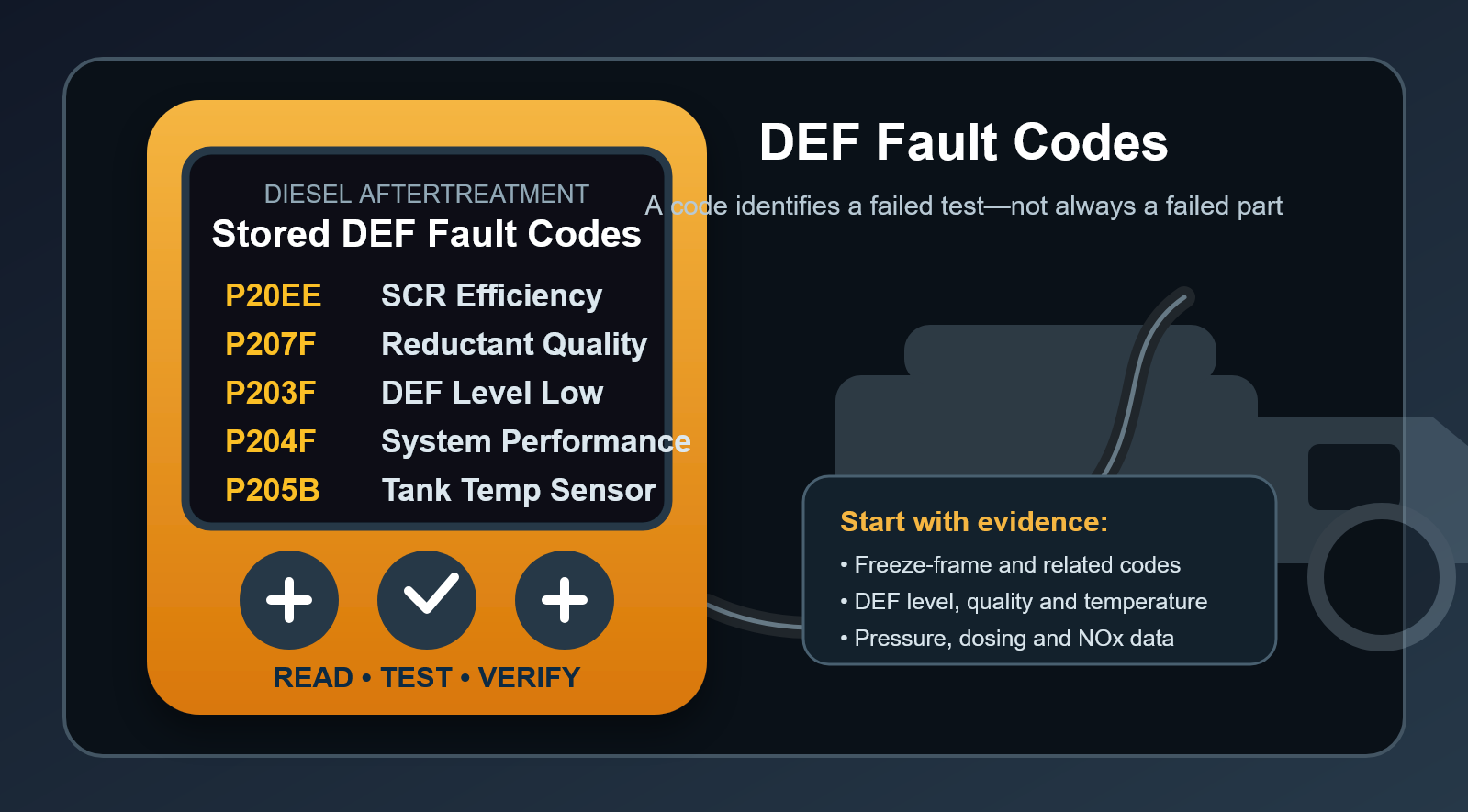
Record coolant and exhaust temperature, vehicle speed, load, DEF level, tank temperature, pressure, and NOx readings when available. A cold-start sensor fault requires a different approach from an efficiency code set during highway driving.
Also check technical service bulletins because software, sensor design, level behavior, and test procedures vary by application.
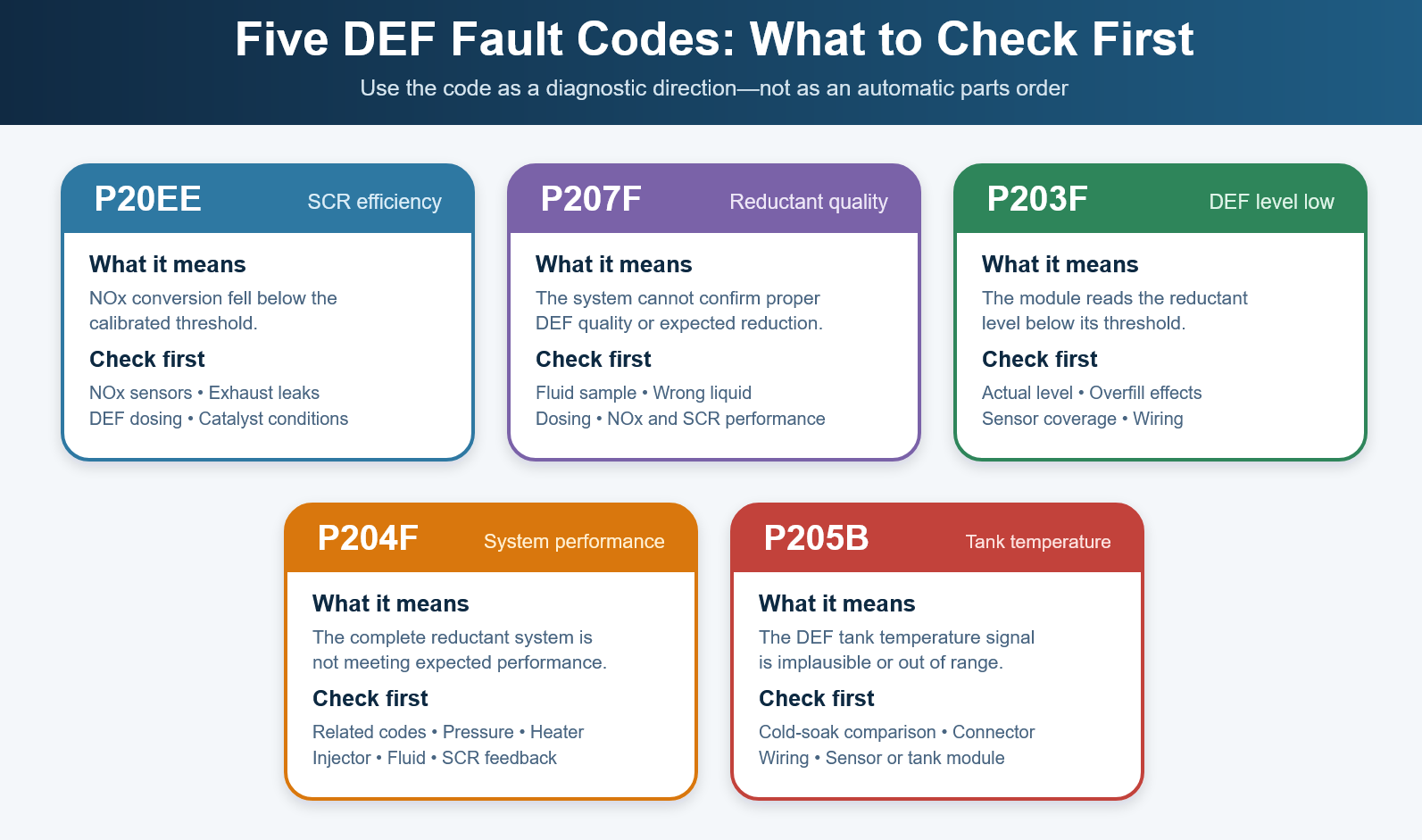
P20EE Code Causes and Fixes
For P20EE code causes and fixes, do not begin by replacing the catalyst. Manufacturer bulletins first direct technicians to verify DEF delivery and overall SCR operation.
- Incorrect dosing or low reductant pressure
- Contaminated, diluted, or incorrect fluid
- Biased upstream or downstream NOx sensors
- Exhaust leaks or invalid temperature conditions
- An aged, contaminated, or damaged SCR catalyst
Test dosing, leaks, sensors, and temperature before condemning the catalyst. Then complete the required verification drive or efficiency test.
P207F Code Reductant Quality
The phrase P207F code reductant quality describes a quality-performance fault. It may mean the DEF composition is wrong, but bulletins also list under-dosing, the wrong liquid, and SCR or NOx-feedback problems.
Test a sample from the tank, not a new container. Check for discoloration, debris, fuel, coolant, water dilution, or mixed products using the approved test for the vehicle.
P203F Code Tank Full
If you search P203F code tank full, the contradiction is the clue. P203F normally means the module reads the reductant level as too low. A full tank can still set the code when the sensor or its reading is wrong.
- Failed or stuck level sensor
- Damaged wiring, pins, or supply voltage
- Crystallized DEF covering the sensor
- Overfilling, freezing, or an unstable reading
- A module or software issue
Confirm actual level and inspect live data. Some Stellantis bulletins describe P203F with sufficient fluid because the sensor is covered or the tank is overfilled.
P204F Reductant System Performance
P204F reductant system performance is a broad code indicating that the Bank 1 reductant system did not perform as expected. It does not identify one failed component.
Look for companion codes involving pressure, heaters, injectors, temperature, level, or NOx efficiency. Then check fluid quality, pump pressure, leaks, crystallization, injector spray, exhaust temperature, and SCR feedback.
P205B DEF Temperature Sensor Code
For a P205B DEF temperature sensor code, compare the tank reading with ambient, intake-air, and coolant temperatures after a long park.
A large cold-start difference can indicate a biased sensor, corrosion, resistance, damaged wiring, or a failed tank module. Confirm whether the sensor is serviceable separately before ordering parts.
A Practical Diagnostic Process
- Save the evidence.
Record all codes, status, freeze-frame data, and dashboard messages. - Check basics.
Confirm DEF level, quality, leaks, crystallization, wiring, and connectors. - Follow related codes.
Diagnose specific circuit or pressure faults before broad performance codes. - Test under valid conditions.
Warm the system and follow the manufacturer’s enable criteria. - Repair the confirmed cause.
Avoid replacing multiple components without evidence. - Clear and verify.
Complete relearns, service tests, and drive cycles, then confirm the code does not return.
Frequently Asked Questions
Can I clear a DEF code and keep driving?
Clearing a code does not fix its cause. Save the data first, diagnose the fault, repair it, and complete the required verification procedure.
Does P20EE always require a new catalyst?
No. DEF dosing, NOx sensors, exhaust leaks, fluid quality, temperature, and software should be checked before catalyst replacement.
Can P207F be caused by a bad sensor?
Yes. Although the code references reductant quality, incorrect dosing or inaccurate NOx and system feedback can also contribute.
Why does P203F appear after filling the tank?
The level may not have registered, or the sensor may be coated, covered, frozen, electrically faulty, or affected by overfilling.
Is P204F safe to ignore?
No. It can lead to warning countdowns or operating restrictions. Diagnose related codes and system performance promptly.
Can cold weather trigger P205B?
Cold weather helps reveal a biased sensor, but a valid code usually points to an implausible temperature signal or circuit problem, not simply cold DEF.
Conclusion
DEF diagnostic codes identify failed system tests. P20EE focuses on SCR efficiency, P207F on quality performance, P203F on a low-level reading, P204F on overall reductant performance, and P205B on tank-temperature plausibility.
Save the data, diagnose related faults, test the complete system, and verify the repair before clearing the warning.
Diagnose the Code Before Buying Parts
Explore our DEF Diagnostic Trouble Codes guides for sensor circuits, dosing faults, pressure codes, SCR efficiency tests, derates, and no-restart messages.

Other Articles
DEF Sensor Problems Symptoms, Testing and Repair
DEF System Problems, Causes, Derate, Reset and Repair
No Comment! Be the first one.