

DEF Shelf Life Expiration, Storage and Date Codes

DEF Shelf Life: Expiration, Storage and Date Codes
Diesel exhaust fluid does not remain at peak quality forever. Heat, direct sunlight, contamination, damaged seals, and long storage periods can reduce its usable life. The date matters, but storage history matters too.
This guide explains DEF shelf life in practical terms. You will learn how long sealed fluid can last, how temperature changes the estimate, how to interpret package markings, and when older fluid should be tested or replaced. Shelf-life tables are planning tools, so give the label and manufacturer instructions priority.
Key Insights
- Properly stored DEF commonly lasts at least 12 months and may last longer in cooler conditions.
- Heat shortens usable life faster than normal freezing and thawing.
- Direct sunlight and contaminated dispensing equipment can reduce fluid quality.
- There is no universal date-code format across every DEF brand.
- Unknown storage history is a warning sign even when the container is unopened.
Does DEF Fluid Expire?
For anyone asking does DEF fluid expire, the answer is yes in the practical sense. The fluid may not fail on one exact day, but its concentration and purity can move outside the SCR system’s required range.
Old or poorly stored fluid may trigger a quality warning, reduce dosing performance, or contribute to deposits. A sealed container prevents contamination but not prolonged heat damage.
How Long Does DEF Last Unopened?
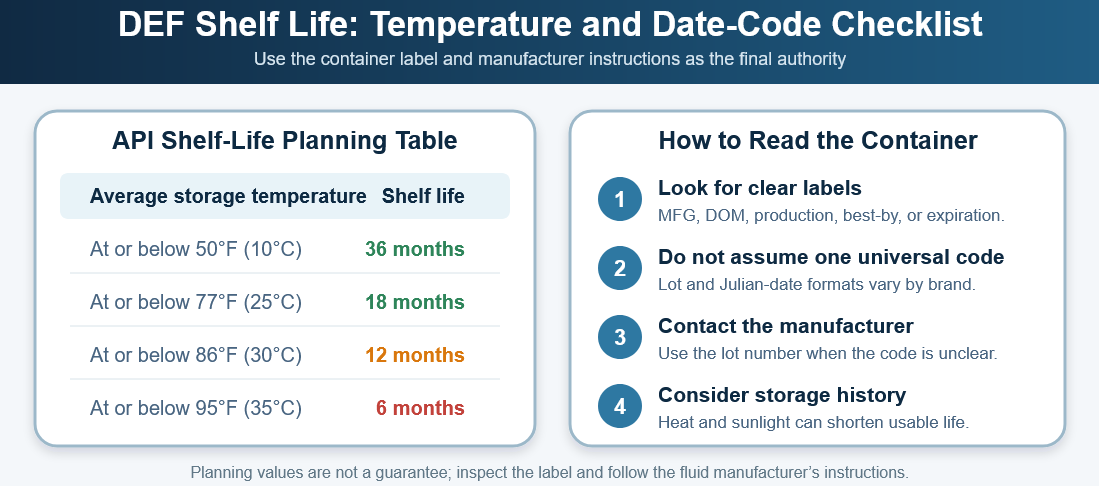
The answer to how long does DEF last unopened depends mainly on average storage temperature. API guidance states that DEF can have a minimum shelf life of 12 months or longer under good conditions. Cooler storage can extend that period.
API’s current planning table gives the following estimates:
| Average storage temperature | Estimated shelf life |
|---|---|
| At or below 50°F (10°C) | 36 months |
| At or below 77°F (25°C) | 18 months |
| At or below 86°F (30°C) | 12 months |
| At or below 95°F (35°C) | 6 months |
These figures assume suitable packaging and clean storage. Heat and sunlight can shorten them.
Best Temperature to Store DEF
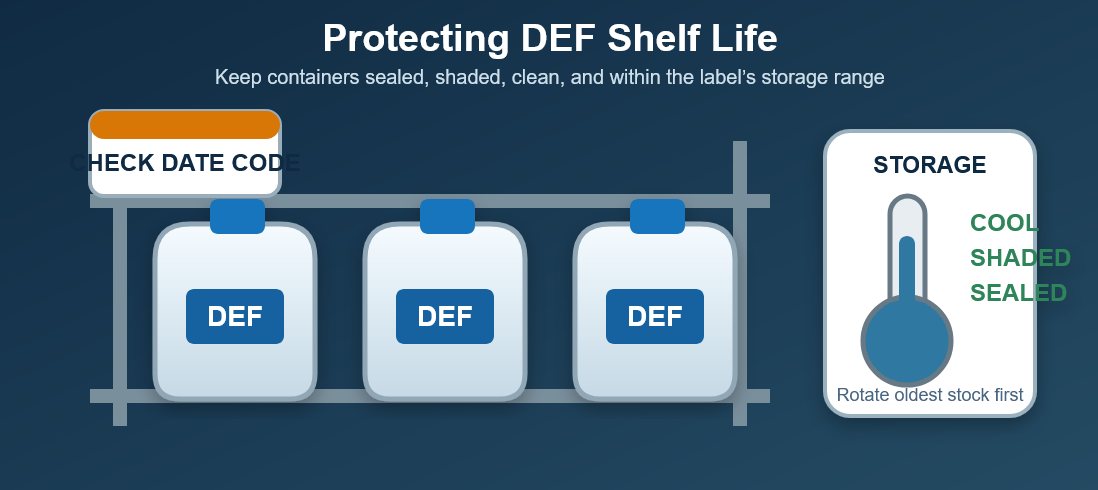
The best temperature to store DEF is a stable, cool range below the high-temperature limits printed on the label. Cummins recommends storage between about 12°F and 86°F and notes that storage below 65°F can extend shelf life.
A cool, shaded indoor area is better than a hot vehicle or outdoor shelf. Protect containers from:
- Direct sunlight
- Daily heat cycling
- Open caps or broken seals
- Dust, fuel, oil, coolant, and tap water
- Containers or pumps made from unsuitable materials
DEF freezes near 12°F, or −11°C, but normal freezing does not automatically ruin correctly formulated fluid. Let it thaw naturally and use the full liquid after it has returned to a uniform state. Do not add water.
How to Read DEF Date Code
There is no universal answer to how to read DEF date code markings because manufacturers use different systems. Some print a clear production date, best-by date, or expiration date. Others use a lot code that includes a year and Julian day.
- Look for plain-language labels.
Search for MFG, DOM, production date, best by, use by, or expiration. - Find the lot or batch number.
It may appear near the cap, handle, label edge, or container base. - Do not use another brand’s formula.
A code-decoding rule from one supplier may be wrong for another. - Contact the manufacturer.
Provide the full lot code when the label does not explain it. - Record the purchase date.
This helps when the production code is difficult to interpret later.
Can You Use Old DEF Fluid?
The safest answer to can you use old DEF fluid depends on its date, appearance, seal, and storage history. Fluid beyond a planning estimate is not automatically bad, but questionable DEF can cost more than replacing the container.
Do not use it when:
- The seal is broken or the cap is damaged
- The fluid is cloudy, discolored, dirty, or contains particles
- Fuel, coolant, water, or another liquid may have entered it
- The storage history includes prolonged high heat or sunlight
- The manufacturer’s expiration date has passed
- You cannot confirm the code or storage conditions
Shops and fleets can test concentration with appropriate DEF-quality equipment, but a normal concentration reading does not identify every possible contaminant. When in doubt, replace the fluid and dispose of the old product according to local guidance.
Expert Storage Recommendations
- Store DEF in its original sealed container whenever possible.
- Keep it indoors, shaded, dry, and well ventilated.
- Use the oldest acceptable stock first.
- Write the purchase or opening date on each container.
- Keep funnels, nozzles, and pumps dedicated to DEF.
- Do not combine old partial containers into one jug.
- Buy quantities that match your normal use rather than overstocking.
Frequently Asked Questions
Does opening a DEF container shorten its shelf life?
It increases contamination risk. Reseal it immediately, store it correctly, and use it sooner than an untouched sealed container.
Can DEF be stored in a hot vehicle?
Short transport is usually unavoidable, but long storage in high heat can shorten shelf life significantly. Move it to a cooler shaded location.
Does frozen DEF expire faster?
Normal freezing and thawing do not usually damage correctly formulated DEF. High heat is generally the greater shelf-life concern.
Can I use DEF that looks clear but is old?
Check the date, seal, storage history, and manufacturer guidance before use.
Should I shake old DEF before using it?
No special shaking is normally required. If the fluid has separated, contains solids, or looks abnormal, do not use it.
Can I mix old DEF with fresh DEF?
Avoid mixing questionable fluid with fresh product because the older batch can contaminate the entire tank or container.
Conclusion
DEF shelf life depends on more than a printed date. Temperature, sunlight, packaging, contamination, and storage history determine whether the fluid remains suitable for the SCR system.
Store containers cool and sealed, rotate stock, decode the manufacturer’s label correctly, and replace fluid when its quality or history is uncertain.
Protect Every Gallon of DEF
Explore our DEF Storage & Shelf Life guides for temperature control, expiration checks, contamination prevention, winter storage, and quality testing.

Other Articles
DEF Crystallization Causes, Cleaning and Prevention
No Comment! Be the first one.